-->
__________________________
WHY SHIDOKAN?
Traditional Okinawan Shorinryu Karatedo
Karate
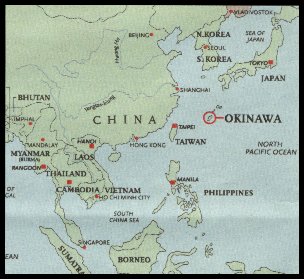
(empty hand) originated in Okinawa, which consists of many Ryu-kyu islands, about 400 miles south of mainland Japan. In
the 1600s the
Japanese samurai ruled supreme and weapons were
forbidden to the Okinawans. In secret they refined what we
now
call karatedo, or the way of the empty hand, until their unarmed
bodies were
as deadly as the swords taken from them. In the more settled
times that followed, the art became valued for its health, strength and
character enrichment.
Okinawan karate is
a cultural treasure and oral tradition that has spread throughout the
world and is practiced by millions.
We
teach karate as weaponless self-defense, and it is emphasized as a
martial art rather
than a sport. It's not about winning tournaments but prevailing
over an assailant of any size or strength. Safety is
paramount! Students are not intimidated, but encouraged to reach
for and attain their highest potential. Achieve
confidence and
expertise while having fun. Improve life skills including a
deeper respect... for yourself and others.
Learning from and helping each other, and using skills
effectively and with good judgment is the true art of karate.
Who Should Take Karate?
Men:
Promoting
good health, self-control, calmness and genuine confidence,
while reducing stress and any tendencies toward inappropriate
aggression.
Women:
Providing skills and attitude necessary for confidence in and
reliance on themselves, not only in the face of danger, but also in other
facets of their lives.
The Elderly:
Maintaining and in most cases improving balance, coordination, agility, flexibility and overall vitality.
TESTIMONIALS... read comments from students & parents
ADULT KARATE
Skills Taught
Blocks, kicks, strikes, safe falls and throws (flips/take downs)
-- with power, efficiency and control. Kata:
Specific
solo moves combine techniques of defense and offense in sequence, so
instant and correct reaction is natural if required to defend
yourself. Complexity increases with rank.
Hold Breaks:
Easy-to-learn practical techniques to break free from an assailant, to use momentum,
leverage and vital striking points to prevail in seemingly
indefensible situations, regardless of size or strength.
Partner Drills:
Practice
of defense and offense skills with increasing difficulty while cooperating
with each other so both partners benefit and improve.
Board Breaks:
Rather
than entirely a specific goal in itself, it also becomes a peripheral benefit -- a
symptom of the strength and focus obtained as a result of karate
training.
Kick/Punch Focus Pads:
Kicks and various strikes to perfect accuracy and balance.
Kumite: 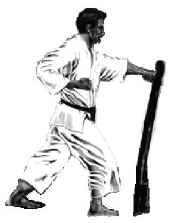
Prearranged
(and "free") sparring enhances timing, reflexes, balance and coordination, as well as safe falls and
throws…with strong emphasis on self-control. Difficulty increases with skill level. Intermediate to advanced
ranks.
Bunkai:
Effective
application of kata with three or four attackers, including safe falls
and throws. Increases spatial awareness, agility and control.
Advanced ranks.
Makiwara (striking board)...pictured right:
To condition and
strengthen while precisely focusing the power of
your entire body to a single point. Advanced ranks.
How to Tie Belt ("Obi")
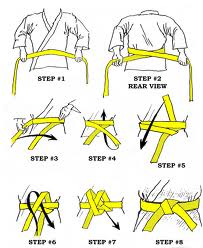
(1) Place the middle of the belt in front of the body. (2) Wrap belt around the back, overlap, and (3) bring back to the front. (4) Make an X with the ends. (5) The top end goes under both segments of the belt from (6) bottom to the top. (7) Tie knot.
IMPORTANT:
Gi pants must not touch the floor/ground. If so, they need to be
hemmed for safety reasons -- our first concern! Floor length can
result in a fall. Rolled-up (they never stay) distracts the
student and can be very dangerous. Correct length is just below
the ankle, or above it but below the knee.
The Bow ("Rei")
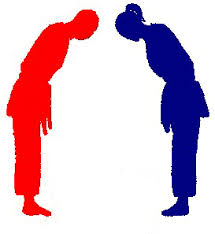 The
bow in karate is often misunderstood.
It holds no spiritual or religious connotation, nor is it a sign of a
master-slave relationship between instructor and student.
Instead, the bow is a cultural practice done to show humility,
appreciation and a willingness to learn. It is also a display
of mutual respect between teachers and students, and
fellow students. It most closely correlates with the Western
tradition's handshake. The bow is from a kneeling (Seiza) or standing position.
The
bow in karate is often misunderstood.
It holds no spiritual or religious connotation, nor is it a sign of a
master-slave relationship between instructor and student.
Instead, the bow is a cultural practice done to show humility,
appreciation and a willingness to learn. It is also a display
of mutual respect between teachers and students, and
fellow students. It most closely correlates with the Western
tradition's handshake. The bow is from a kneeling (Seiza) or standing position.
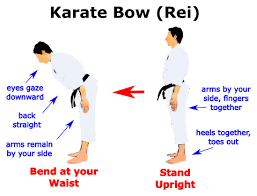 Students
bow when entering the dojo (training area), clearing their minds
of distractions, committing to fully focus on and attempt to absorb the
material about to be taught. Bowing toward instructor is to
show respect and gratitude for the time and energy devoted to sharing
his/her experience, skills and knowledge. Bowing is to be done
between students before and after kumite, bunkai and partner drills.
The ending bows express thanks for furthering each other's
skills, and the learning about themselves and their partners.
Bowing upon exiting the dojo signifies that training has
finished -- for the moment or for the day -- until time to return.
Students
bow when entering the dojo (training area), clearing their minds
of distractions, committing to fully focus on and attempt to absorb the
material about to be taught. Bowing toward instructor is to
show respect and gratitude for the time and energy devoted to sharing
his/her experience, skills and knowledge. Bowing is to be done
between students before and after kumite, bunkai and partner drills.
The ending bows express thanks for furthering each other's
skills, and the learning about themselves and their partners.
Bowing upon exiting the dojo signifies that training has
finished -- for the moment or for the day -- until time to return.
- Always bow ("rei") when bowed to, and...
- Upon entering & exiting training area;
- Before joining or leaving class;
- When summoned by Sensei or sempai;
- Upon meeting & leaving Sensei or sempai;
- Before & after kata;
- Before & after class.
Seiza - Formal sitting (kneeling) position
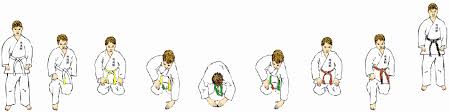
Left knee down first then right knee,
with right great toe crossed over left great toe; knees apart; sit
on feet; hands on thighs. Left hand down first, then
right. Bow ("rei"). Right hand up first, then left.
To rise: Right knee up first, then left into standing
position. See also The Bow.
Karatedo Directive
Understanding the spirit of karate:
No
attacks are initiated by a karate practitioner. Instead there is
love of peace, pursuit of harmony and respect for humanity.
Karate begins and ends with courtesy:
Courtesy and respect toward your superiors, equals and beginners is necessary for personal growth.
Practice must be done in utmost sincerity:
Kata, kumite and bunkai practice must be done with sincere belief that you are facing an actual enemy.
Follow the instructions of your sensei and sempai to the best of your ability:
Do
not hold a critical attitude toward your instructors or your progress will suffer. If you do not
understand, ask your instructor to explain.
Do not attempt to advance too rapidly:
A
solid foundation must be built carefully and cannot be rushed.
Only through perseverance and patience will you reach your goals.
Beware of becoming self-satisfied, boastful or arrogant:
Dedicated practice will bring desired results. To be humble of your
skill begets more practice, and thus more skill.
Dojo Manners & Rules
Karatedo will help students ("karate-ka") achieve: Humility, integrity, and respect for themselves and others,
as well as a spirit of cooperation with fellow karate-ka, assistant instructors and other
higher-ranked students ("sempai"), and the teacher ("Sensei").
- Address as Sensei: Seikichi Iha, Grand
Master...always; and Sharon
Basinger, Chief Instructor. Also: In Sensei Basinger’s
absence, black belts while instructing at Karate STL. Black
belts
while instructing at other dojos. Ask Sensei Basinger if in doubt.
- Address as Sempai
or Mr./Ms: Sensei's assistants and karate-ka higher ranked than you but below black belt –
Sempai, or Mr./Ms., then last name, or first name if they prefer – e.g.
“Sempai Chris” or “Mr./Ms. Chris.” Ask Sensei if unsure.
- Observers/Parents: ALL ages are kindly requested to remain upstairs or outside, due to the lack of space.
- When late, it's impolite to simply walk into class. Instead, quietly warm up by yourself, apart
from class. Then do not join the class yet... stand and wait,
just inside the dojo, until instructor signals you to enter.
- During
class, do not leave training area early, or leave for a break,
to talk to observers/parents, etc., without first clearing it with instructor.
- Wait to be notified by Sensei Basinger, as to if or when you will test for promotion, rather than inquiring.
- Respect all instructors/sempai and follow their directions without question,
comment, hesitation or facial expression while in dojo. For
clarification, ask Sensei Basinger privately, apart from others,
outside class.
- When interacting with other karate-ka, especially those
lower in rank, ALWAYS consider their age, skill level, size, strength and
any limitations. Then adjust your speed and power accordingly. Help
each other!
Karate STL Director & Chief Instructor
Kyoshi 7th Dan
Shibu Dojo Director in State of Missouri for
Beikoku Shidokan Karatedo Association
Sharon Basinger
(Contact Sensei Basinger)
(left) began training in Shidokan in 1989, and has been
the Director/Chief Instructor at Karate STL since its inception in 1995. 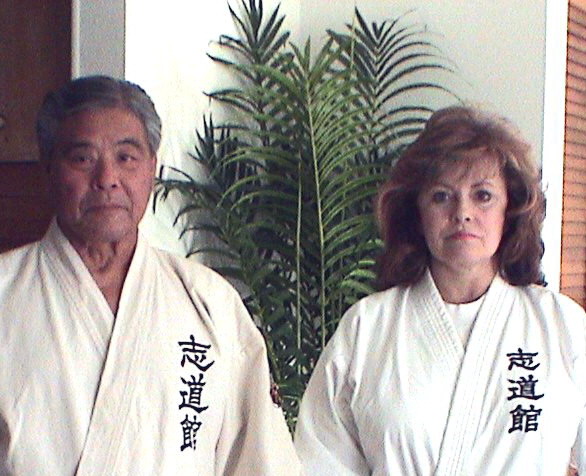 She
attained the internationally recognized and documented title of Kyoshi*, and rank of 7th Dan ("black belt" degree, but actual belt of 7th Dan is red and white), awarded by
world-renowned Grand Master Seikichi Iha, Hanshi 10th Dan (right),
and the
Okinawa Shorinryu Karatedo Association. Karate STL and
Basinger Sensei are under direct supervision & guidance of Iha Sensei, who
is the President of Beikoku Shidokan Karatedo
Association. Basinger is that
Association's Shibu (branch) Dojo Director in the state of
Missouri. She is on the Beikoku Shidokan Shorinryu Black Belt
Examination Committee. She also actively oversees a Fuku Shibu**
(sub-branch) dojo, comprising four separate training locations,
in addition to Karate STL. Basinger previously studied judo, and
other styles of karate but she and her late husband, Gordon Basinger, concluded that Shidokan
not only promised but also provided the authentic training and
philosophy they had been seeking all along.
She
attained the internationally recognized and documented title of Kyoshi*, and rank of 7th Dan ("black belt" degree, but actual belt of 7th Dan is red and white), awarded by
world-renowned Grand Master Seikichi Iha, Hanshi 10th Dan (right),
and the
Okinawa Shorinryu Karatedo Association. Karate STL and
Basinger Sensei are under direct supervision & guidance of Iha Sensei, who
is the President of Beikoku Shidokan Karatedo
Association. Basinger is that
Association's Shibu (branch) Dojo Director in the state of
Missouri. She is on the Beikoku Shidokan Shorinryu Black Belt
Examination Committee. She also actively oversees a Fuku Shibu**
(sub-branch) dojo, comprising four separate training locations,
in addition to Karate STL. Basinger previously studied judo, and
other styles of karate but she and her late husband, Gordon Basinger, concluded that Shidokan
not only promised but also provided the authentic training and
philosophy they had been seeking all along.
* Kyoshi description per Beikoku Shidokan Association By Laws:
"Knowledgeable Person." He/she is a senior member who has gained
the respect of members from all over, as well as his/her teacher.
The Kyoshi is recognized as being able to represent the Hanshi anywhere
the Kyoshi travels. The Kyoshi is also a Certified Instructor.
Read more about Basinger Sensei (her continuous training; background; favorite quotes; Gordon Basinger Sensei)
Black Belts/Instructors
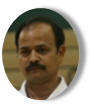
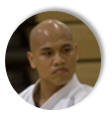
Ameer
Syed (left), Sensei 5th Dan and Fuku Shibu Dojo** Director. Tony Bui (right), 5th Dan, Instructor. Kevin Queen (below center), Laura Jenkins and George
Fortier (not pictured), 2nd Dan. Not pictured: Natalie Bernhardt-Steed, Kristina Carpenter, Glenda and
Bryan Petrofsky, John Hays, Alex Dyachenko,
1st Dan.
Junior Black Belts (not pictured)
are Stephanie Bartram, Tawni
Miranda, Krystal Carpenter, Candice Turner. (Kristina Carpenter,
Laura Jenkins and Natalie Bernhardt-Steed progressed from junior black
belt to an adult black belt rank).
As
a supplement to
their training, these dedicated students also travel when possible to Lansing, Michigan, for even further instruction from
Iha Sensei. They all began as white belts at Karate STL and have since
achieved their internationally certified ranks due to diligent training in this dojo.
** Fuku
Shibu (sub-branch) Dojos... are under the guidance and supervision of
their Sensei/Shibu (branch) Dojo Director -- in this case Basinger Sensei -- who is directly under the Hombu (headquarters) Dojo Director, Grand Master Seikichi Iha, Hanshi 10th Dan. Basinger Sensei was proud and very
pleased to approve and recommend dojo certification,
for the above referenced Fuku Shibu Director, Ameer Syed.
 (To top)
Links & Affiliated Dojos
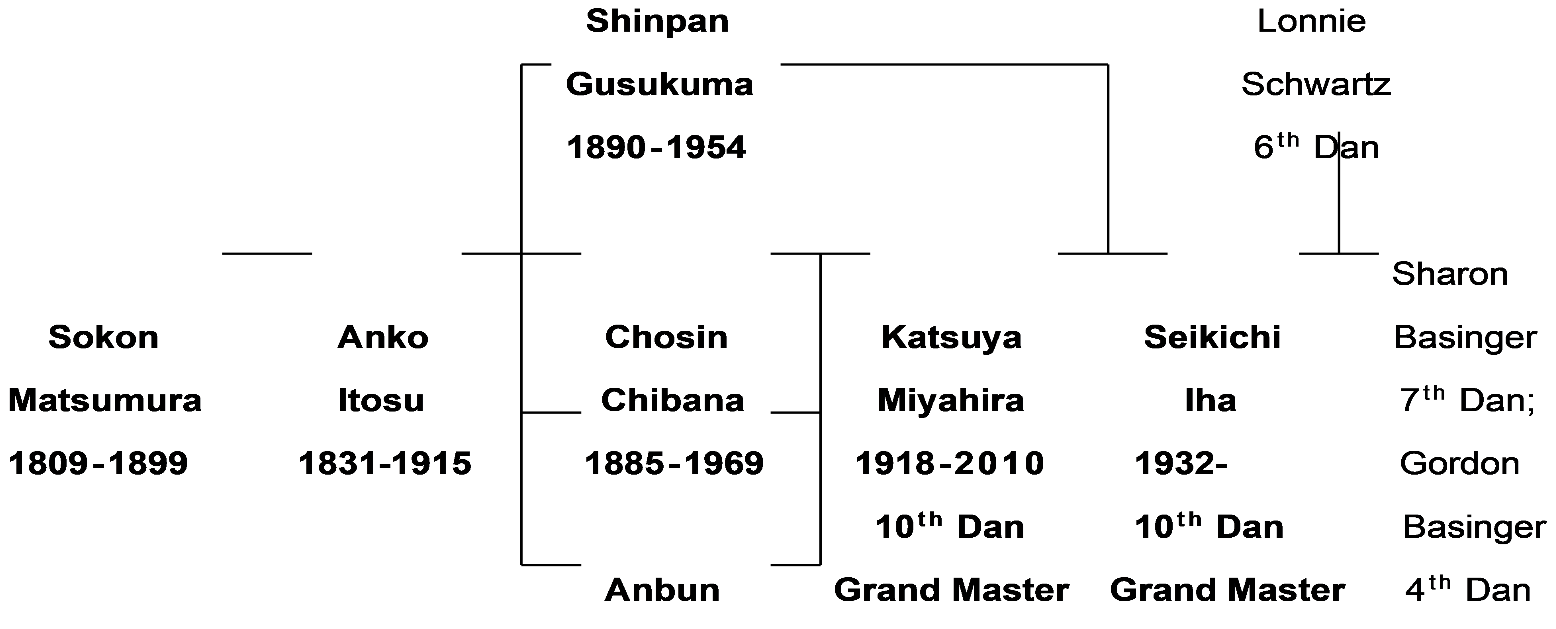
Lineage Chart
Honorable Masters
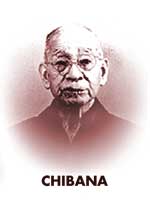 Grand
Master CHOSHIN CHIBANA, Hanshi 10th Dan (1885-1969), born June 5, in Shuri City, Okinawa, began training in 1900 at the
age of 15 with Grand Master YASUTSUNE "Anko" ITOSU.
Itosu Sensei is considered the
Father of Okinawan Karate and is the first person responsible for
publicly teaching the art. Chibana Sensei was the originator
of Okinawan Shorinryu, loosely translated as "small forest style" or
"pine forest
style." He also formed the Okinawa Shorinryu Karatedo
Association in 1950 and was its first president. Among Chibana's
many awards was the Kunyonto (4th) Order of the Sacred Treasure
presented by the Emperor of Japan, Hirohito, for his devotion to the
study and practice of Okinawan karatedo. He taught almost until
the time he died of cancer at the advanced age of 83. His
successor was Katsuya Miyahira.
Grand
Master CHOSHIN CHIBANA, Hanshi 10th Dan (1885-1969), born June 5, in Shuri City, Okinawa, began training in 1900 at the
age of 15 with Grand Master YASUTSUNE "Anko" ITOSU.
Itosu Sensei is considered the
Father of Okinawan Karate and is the first person responsible for
publicly teaching the art. Chibana Sensei was the originator
of Okinawan Shorinryu, loosely translated as "small forest style" or
"pine forest
style." He also formed the Okinawa Shorinryu Karatedo
Association in 1950 and was its first president. Among Chibana's
many awards was the Kunyonto (4th) Order of the Sacred Treasure
presented by the Emperor of Japan, Hirohito, for his devotion to the
study and practice of Okinawan karatedo. He taught almost until
the time he died of cancer at the advanced age of 83. His
successor was Katsuya Miyahira.
Chibana Sensei's thoughts and advice on karate.
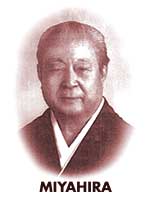 Grand
Master KATSUYA MIYAHIRA
Hanshi 10th Dan,
was born on August 8, 1918 in Nishihara City,
Okinawa, and died on November 29, 2010 in Naha, Okinawa, at age
92. Miyahira Sensei started his training with Grand Master Choshin Chibana at
age 15. In 1937, he worked as a school teacher in Manchuria
and taught self-defense. He opened a dojo in Kanehisa, Nishihara,
in 1948 naming it "Shidokan." After Chibana Sensei's death in 1969,
Miyahira became the President of the Okinawa Shorinryu Karatedo
Association. He was presented with the 1989 Martial Arts
Distinguished Service Award (the highest honor of its kind in the world
of Japanese martial arts) by the president of the Japan Martial Arts
Council. Among Miyahira's major contributions has been the
introduction of obligatory analytical exercises (bunkai) for each of
the kata, and the deepening of the philosophical study of karatedo. His most senior student is
Seikichi Iha.
Grand
Master KATSUYA MIYAHIRA
Hanshi 10th Dan,
was born on August 8, 1918 in Nishihara City,
Okinawa, and died on November 29, 2010 in Naha, Okinawa, at age
92. Miyahira Sensei started his training with Grand Master Choshin Chibana at
age 15. In 1937, he worked as a school teacher in Manchuria
and taught self-defense. He opened a dojo in Kanehisa, Nishihara,
in 1948 naming it "Shidokan." After Chibana Sensei's death in 1969,
Miyahira became the President of the Okinawa Shorinryu Karatedo
Association. He was presented with the 1989 Martial Arts
Distinguished Service Award (the highest honor of its kind in the world
of Japanese martial arts) by the president of the Japan Martial Arts
Council. Among Miyahira's major contributions has been the
introduction of obligatory analytical exercises (bunkai) for each of
the kata, and the deepening of the philosophical study of karatedo. His most senior student is
Seikichi Iha.
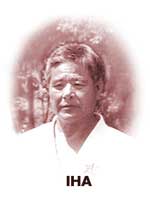 Grand Master SEIKICHI IHA,
Hanshi 10th Dan was born July 9, 1932 in Nishihara City, Okinawa
Japan. He passed away peacefully in his home surrounded by his
children and many friends on August 3, 2024 in Lansing, Michigan. He was 92 years old. Karate STL and Sharon Basinger were directly under the supervision and teaching of
this world-class master. He was
United
States Branch Chief for the Okinawa Shorinryu Karatedo Association,
and the President of the Beikoku Shidokan Karatedo
Association. A "teacher of teachers," Iha Sensei was the highest ranking
Okinawan master residing in the United States.
Grand Master SEIKICHI IHA,
Hanshi 10th Dan was born July 9, 1932 in Nishihara City, Okinawa
Japan. He passed away peacefully in his home surrounded by his
children and many friends on August 3, 2024 in Lansing, Michigan. He was 92 years old. Karate STL and Sharon Basinger were directly under the supervision and teaching of
this world-class master. He was
United
States Branch Chief for the Okinawa Shorinryu Karatedo Association,
and the President of the Beikoku Shidokan Karatedo
Association. A "teacher of teachers," Iha Sensei was the highest ranking
Okinawan master residing in the United States.
In 2001
Iha was awarded the rank of 10th Dan from Grand Master Katsuya Miyahira. There was an enthusiastic standing ovation of world-wide friends, family and
hundreds of
his students at the Beikoku Shidokan 25th
Anniversary Celebration in Lansing, Michigan.
In August 2019, hundreds of Iha Sensei's students and friends traveled
to Okinawa for his “Tookachi” celebration. It’s a person’s 88th
birthday/birth year, and is called “Tookachi” in Okinawa, and “Beiju”
in
mainland Japan. It is one of the two biggest birthday
celebrations, the other being the 97th anniversary, also known as
“Kajimayaa.” The Tookachi celebration typically takes place on
the 8th day of the 8th month of the lunar calendar.
On May 19, 2020, the Okinawa Prefectural Board of Education announced:
Grand Master, Seikichi Iha, Hanshi 10th Dan, was recognized as an
OKINAWAN INTANGIBLE CULTURAL ASSET by the Okinawan government. This is the highest award to be
bestowed upon an Okinawan Karate Master...and the first time this was awarded to someone living outside Okinawa!
His
initial karate training was with his uncle but in 1950 he became a
student of SHINPAN GUSUKUMA,
a student of the famous
Anko Itosu. After Gusukuma's death in
1954, Iha began training with Miyahira Sensei.
He has taught in Guam, the
Philippines and Okinawa. In 1964 he also trained U.S. Marines at
Futenma, Okinawa. 1967 to 1975 he taught in Los Angeles,
California. In 1975 he opened his Lansing, Michigan,
dojo which is now headquarters for over 30 schools in the U.S.,
Canada and other countries as distant as Sweden and Israel. Iha wss frequently visited, consulted and revered by karate
practitioners from around the globe.
More
about Iha Sensei, including details regarding his Tookachi, and his recognition as an
Okinawan Intangible Cultural Asset. As well as what Iha Sensei
hoped for his students.
Iha Sensei biography, and an interview on karate.
Beikoku Shidokan Karatedo Association, Seikichi Iha, President.
About; membership application; association directory; events; and more.
History
Okinawan, Shorinryu, and Beikoku Shidokan karate history.
Biographies of great masters: Matsumura, Itosu, Chibana, Gusukuma, Motubu and Miyahira.
Karate STL Chronology
From 1995 to the present.
(To top)
